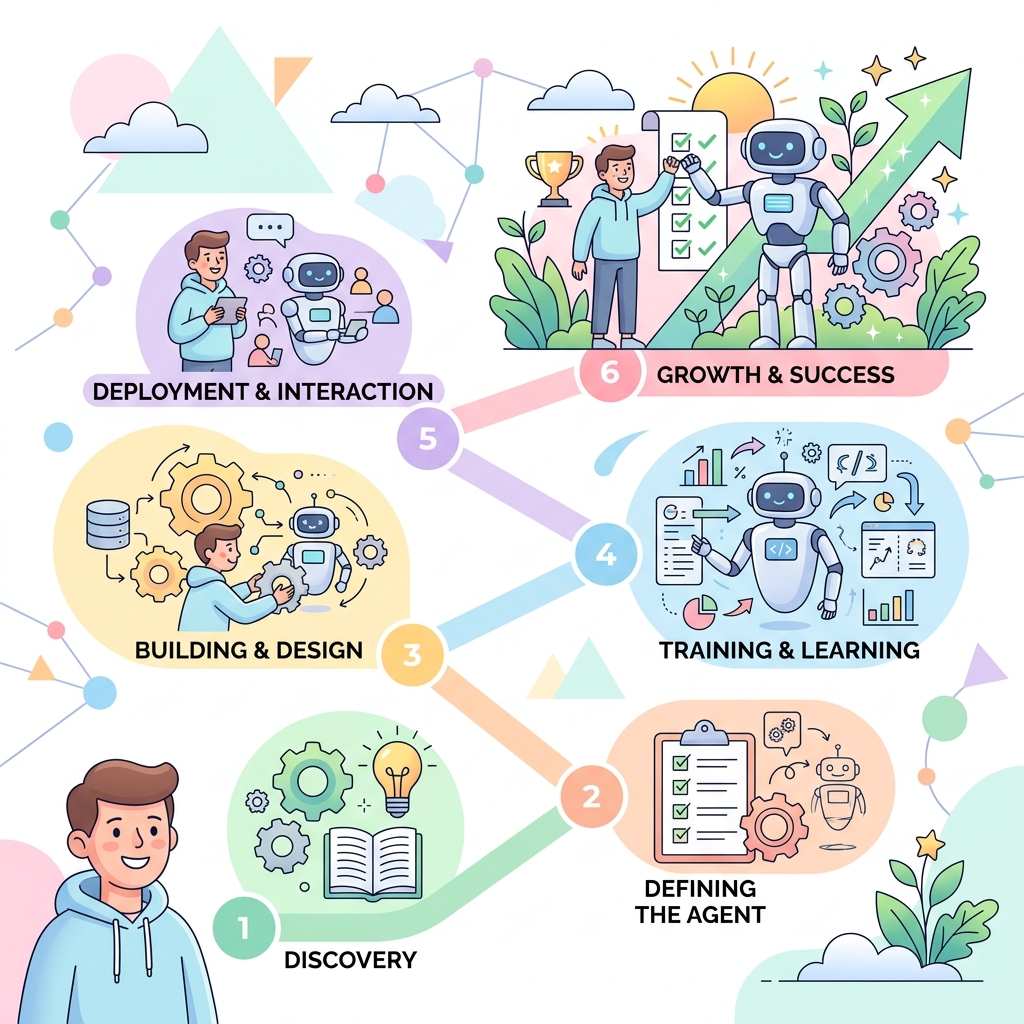
If you have followed artificial intelligence recently, you have likely heard terms like "generative AI" and "large language models" (LLMs). But a new phrase is rapidly taking over: Agentic AI. This represents the next monumental leap in tech, shifting from systems that simply answer questions to systems that autonomously execute multi-step operations.
What is Agentic AI?
At its core, Agentic AI refers to artificial intelligence systems (often called autonomous AI agents) that possess agency. Unlike traditional chatbots that wait for a user's prompt to generate a single response, agentic systems have the built-in capability to reason, formulate plans, use digital tools, and self-correct their errors to achieve a specific target goal.
"Agentic AI is the transition from AI as a passive responder to AI as an active, goal-driven executor."
Generative AI vs. Agentic AI: The Key Differences
To understand why this is a breakthrough, let's compare them:
- Generative AI: You write a prompt (e.g., "Write an email to a client"), and the model outputs text. The workflow stops there. If you want to send it, you must copy, edit, and send it yourself.
- Agentic AI: You give a high-level goal (e.g., "Schedule a kickoff meeting with John and follow up with the project spec"). The agent checks calendar availability, drafts an email matching your voice DNA, sends the meeting invite, monitors for a reply, and registers the spec in your project board—all without manual intervention.
Real-World Examples of Agentic AI in Action
Agentic systems are transforming operations across industries. Here are some key real-world examples:
1. Autonomous Software Engineering
Instead of just suggesting code blocks, agentic software engines can spin up local test runs, write full features, execute build commands, read lint errors, and write fixes autonomously until all tests pass.
2. Human-Centric Brand Management
In marketing and communication, agents verify content against a company's strict Brand DNA. They can draft blog posts, select appropriate media, format layouts, and publish pages directly, while ensuring tone guides and contrast ratios are fully respected.
3. Dynamic Customer Support Operations
Moving beyond simple predefined menus, agentic support systems query database records, issue refunds, coordinate with shipping APIs, and follow up with customers, escalating to human operators only when resolving complex disputes.
How an AI Reasoning Engine Works
Autonomous agents function by running a continuous loop commonly referred to as the PEAS model:
- Perceive: The agent receives an objective and scans the digital environment.
- Evaluate: It reasons through the path forward, predicting potential failures.
- Act: It selects a tool (e.g., database query, web search, API call) and runs it.
- Self-Correct: It inspects the outcome. If a command fails, it edits its plan rather than giving up.
Embracing the Agentic Future
As agentic software platforms like WavoLabs AI build out the execution layer for the modern web, we are moving away from manual tool operation. In the AI-first world, success is driven by defining clear intentions and letting autonomous systems turn them into precise actions.